


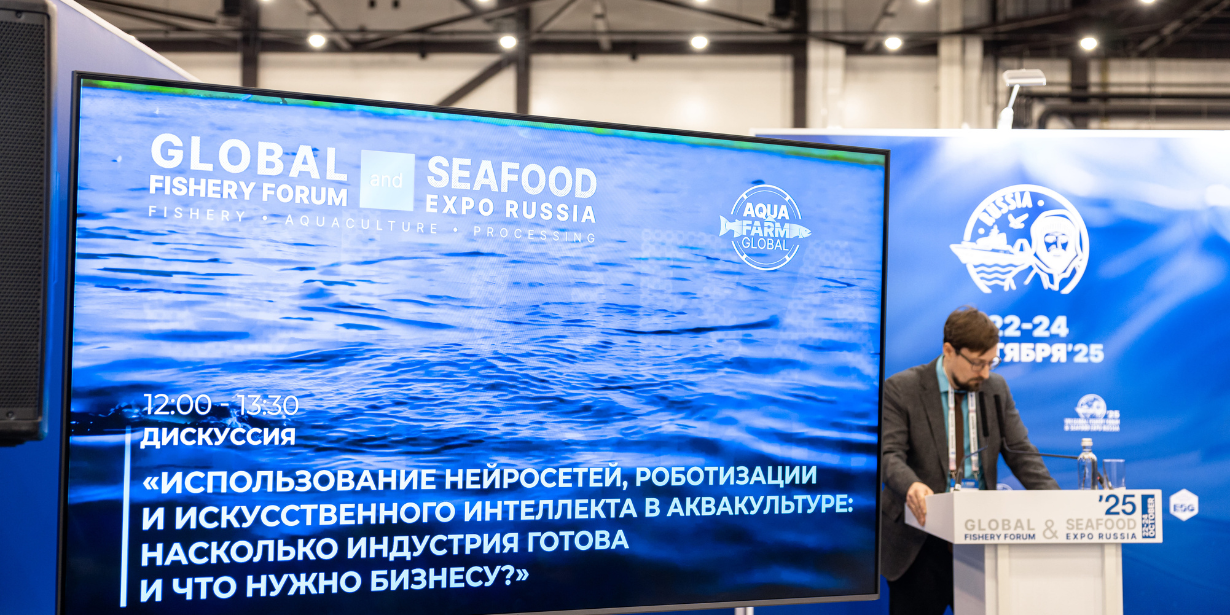
A rich discussion on the use of artificial intelligence in aquaculture and fisheries took place at the round table 'Neural Networks, Robotics, and AI in Aquaculture: Is the Industry Ready and What Does Business Need?' as part of VIII Global Fishery Forum & Seafood Expo Russia 2025.
The participants discussed the use of artificial intelligence in aquaculture and fisheries, focusing on practical aspects. They considered the advantages and opportunities of technologies, as well as the risks, economic constraints and obstacles to their widespread implementation
The meeting was moderated by Alexey Romanov, General director/Co-founder, Fogstream LLC. In his report, he spoke about global trends and highlighted key areas of development. Among them are intelligent feeding systems, water quality monitoring using IoT solutions, computer vision to assess volume and biomass, robotic sorting, as well as analytical platforms that combine data from sensors and cameras.
Andrey Tolstikov, Head of the Sales Department, Machine Vision and Neural Networks, Nord Klan LLC, spoke in detail about the possibilities of technological solutions: taking into account the number, weight, size and behavioral characteristics of fry and adult fish, as well as distinguishing between living and dead individuals. In addition, he presented a complex for end-to-end quality control at all stages of processing - from cutting fish to the production of finished products. The system records employee operations, tracks technological deviations and assesses the compliance of products with acceptable parameters before entering the market.
Alexander Zavyalov, Chief Specialist of the Department of Technology and Regulation of Aquaculture of VNIRO, noted that the key problem for the integration of technologies remains high price. Optical weighing and monitoring equipment is very expensive, so only a few large farms in Russia can afford it. Small farms are practically deprived of access to such technologies. However, the expert expects that the situation will change in 5-8 years with the arrival of cheaper Chinese solutions. He expressed a desire to see domestic developments as well.
On behalf of the scientific institute, Zavyalov called for cooperation: the creation and implementation of data analysis systems requires the joint work of developers, industrialists and investors, as well as the material and technical base. He proposed to create state data centers for centralized data processing, guaranteeing confidentiality to dispel business fears of exchanging information with government agencies.
Vladimir Bokov, Software Engineer and IT Specialist, Creator of the Telegram channel «RAS Help: Answers About RAS» named basic routine operations, in particular, regulation of environment parameters, as priorities for automation. He stressed that solutions are always adapted to the budget and needs of the client - from simple cloud tools for data recording to complex management systems. Vladimir Bokov highlighted two key problems of the industry: insufficient awareness of manufacturers who do not understand the benefits of digital solutions, and the shortage of specialists who have both knowledge of fish farming and digital technologies in aquaculture.
Alexey Marakhtanov, Director, Internet Business System LLC, Head of the Artificial Intelligence Center, Petrozavodsk State University, noted that the main concerns of manufacturers and investors are related to the different readiness of enterprises. Many are ready only for basic digitalization, such as electronic logs, parameter accounting and monitoring, and see the introduction of AI and robotization as the next step. Technological complexity and high cost of the hardware remain the main barriers. Nevertheless, Marakhtanov noted positive dynamics: some partners are already building sustainable solutions, and with the adaptation of technologies to real budgets and staff training, the implementation is gradually advancing.
Digital solutions are also in demand among fishermen. Catch maps with fish points are being developed for them. Semyon Paramonov, General Director of Digital Sea Solutions, stressed that forecasting requires an integrated approach. The behavior of fish depends on many parameters of the environment - temperature, concentration of substances, salinity and others. They are assembled by satellites, sensors, video cameras, air or underwater drones, and machine learning models highlight target zones on the map. It is important to evaluate these parameters not only at the moment, but also in time, which requires large databases. This requires complex solutions and a diverse set of technical means that can be adapted to the scale of the territory.
Pavel Popov, Director for Development, Digital Marine Solutions LLC; Skolkovo mentor, noted the impact of large-scale industrialization on prices. He called for taking into account the economic model when bringing products to the market and emphasized the great, yet undiscovered potential of the Russian AI market. There are numerous startups in the regions that are ready to grow, provided that they join forces and attract investments.
Within the framework of the session, the participants repeatedly emphasized the need for systematic collection and reliable anonymization of data. For the successful implementation of AI in aquaculture, it is necessary to adapt educational programs to prepare specialists for new digital standards. This includes the development of skills in working with data, algorithms and interdisciplinary interaction between fish farming and IT. In conclusion, the speakers expressed their readiness for a deeper study of the presented cases. Organizers and participants are confident that further implementation of AI, robotization and analytics will increase productivity, reduce losses and ensure sustainable growth of the industry.
The organizer of the round table is "Fogstream".
The event was held as part of the AQUA FARM GLOBAL special exposition, organized with the support of Sphere Mediagroup at the Seafood Expo Russia exhibition in St. Petersburg on October 22-24.

The roundtable "Technological Aspects of Cost-Effective Aquaculture" was held within the framework of AQUA FARM GLOBAL
More
The round table brought together representatives of science and business for an open dialogue
A rich discussion on the use of artificial intelligence in aquaculture and fisheries took place at the round table
More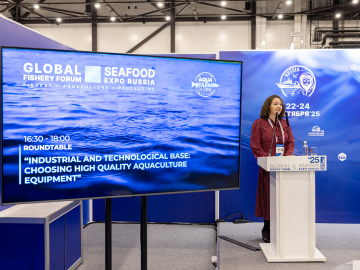
Choosing of high quality aquaculture equipment was discussed at AQUA FARM GLOBAL 2025
More
Kemal Cem Pülten, Editor-in-Chief, Aqua Life of Türkiye Publishing Group
More
What have you already discussed and what's ahead?
More
We are pleased to present an overview of new Russian participants in the special aquaculture and mariculture exposition
More
A few new international exhibitors making their debut at this year’s event
More
Which Chinese practices in aquaculture might be adapted successfully to Russian conditions?
MoreThis website uses , to ensure the best user experience and functionality of the site. By continuing to use this site, you agree to the use of cookies

