


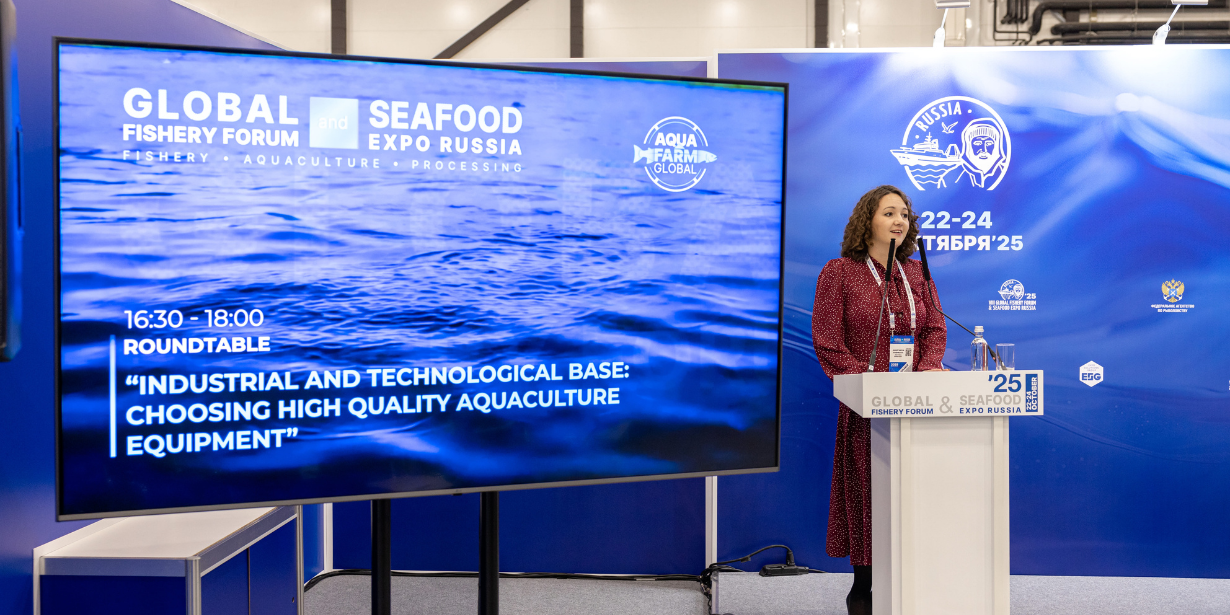
The roundtable "Industrial and Technological Base: Choosing High Quality Aquaculture Equipment" was held on the first day of the specialized exposition AQUA FARM GLOBAL 2025. The moderator of the round table was Anastasia Dashkova, Head of the Business Program, Media Group SPHERE . The participants spoke about modern solutions for kindergartens and industrial farms, prospects for localization of production, as well as about technological challenges that restrain the development of aquaculture in Russia.
The participants of the event were: Irina Zakharevich, Executive Director of the Net-Making Factory "LYUKSOL", Trademark/Legal Entity LLC "LUMEN"; Sergey Galizin, General Director LLC "Hermes"; Sergey Novikov, CEO, Russian Caviar House Group; Michael Yanechek, Managing Director, GRYF HB, Ltd. (Czech Republic); Alexander Trusov, Development Director, ASAKUA; Sergey Sklyarov, Director of the V.I Naumov Institute of Animal Husbandry and Aquaculture, St. Petersburg State Agrarian University.
Alexander Trusov spoke about the company's international experience and its strategy of presence in the Russian market. The main task of ASAKUA, according to the speaker, is to transfer technologies and knowledge that will allow the development of aquaculture. He presented innovative solutions for the automation of aquafarms, which have not yet become widespread in Russia.
Automatic feeders with IoT system, allowing the operator to control the feeding process on the whole farm from one computer.
Feed guns for cage farms, providing accurate dosing and control of feed consumption.
Feed barges and feed containers of various capacities.
Underwater cameras and monitoring systems.
Monitoring buoys that record temperature, oxygen level and weather conditions.
Sergey Novikov outlined the main challenges facing the industry. According to him, world fishing is reaching resource limits, and it is the RAS that becomes a growth tool. The development of this direction is hampered by the high cost of equipment, energy consumption and the lack of real state programs to support the construction of RAS. The choice of quality equipment allows to reduce technological risks, labor costs, improve cultivation, as well as stabilize biological conditions.
The expert noted that today it is especially important for manufacturers to establish cooperation with universities and create training programs for young specialists in order to make up for the shortage of personnel in the industry and improve the qualifications of future technologists. The topic of personnel training became one of the most discussed at the round table - both speakers and the audience showed interest in it.
Sergey Sklyarov told about how scientific institutions participate in the development of the technological base of the industry. At Institute of Animal Husbandry and Aquaculture, St. Petersburg State Agrarian University has already created a laboratory where the elements of RAS are worked out, research in the field of computer vision and automation is carried out. Joint projects with partner enterprises allow students to practice in production, and companies to influence the technological development of the industry.
The expert also presented a comparative analysis of the effectiveness of pools of different designs:
Polypropylene - strong and easy to install, but have a high cost with a large number of pools, and are also limited in size.
Concrete - the most durable and allow you to create tanks up to 500 cubic meters, but are difficult to maintain and transport.
Fiberglass - light and durable, while more fragile and expensive in production.
Sergey Sklyarov emphasized that the choice of shape also affects productivity: round pools provide better circulation and self-cleaning, square pools - rational use of space, but require more attention during maintenance, oval ones have a high self-cleaning coefficient and effectively use space, but the design is difficult to install.
Irina Zakharevich spoke about modern materials for the production of netting chambers and the requirements for the equipment of garden trusses. LUXOL has introduced a new generation of materials made of high-molecular polyethylene, which has increased strength, lightness and resistance to ultraviolet radiation. Irina also shared other solutions of the company: polyamide nets with UV stabilizer, treatment against overgrowth of nets (antifouling), collectors for removal of bottom waste and accounting for fish losses.
Sergey Galizin continued the topic of equipment for horticultural farms. The company "Hermes" is engaged in the production of pontoons, cages and anchor systems for fishing enterprises. Sergey emphasized that the development of aquaculture is impossible without reliable and environmentally friendly structures. The collapsible design of the gardens makes it easy to carry out repair work. The speaker presented visual cases of kennery enterprises of different complexity, noting the importance of selecting the optimal equipment for effective cultivation.
Michael Yanechek made a final report. He told about precise physical measurements in aquaculture. The speaker stressed that today the efficiency of fish farms directly depends on the quality of monitoring water parameters and the accuracy of the data obtained in real time. Modern sensors allow you to record oxygen concentration, temperature, pH level, turbidity and other key indicators, which helps technologists respond to changes in the environment in a timely manner. The water condition also affects the operation of the equipment.
As a result of the round table, it can be concluded that Russian aquaculture is entering a new stage of development. The main areas that determine the sustainability and efficiency of the industry include:
Localization of equipment and materials production.
Implementation of digital solutions and automated control systems.
Development of human resources and applied science.
Formation of uniform quality standards.
The event was held as part of the AQUA FARM GLOBAL special exposition, organized with the support of Sphere Mediagroup at the Seafood Expo Russia exhibition in St. Petersburg on October 22-24.
JSC "Rybnyye Korma" – a major Russian producer of feed for industrial aquaculture
More
One of Russia’s leading producers of feed for industrial aquaculture will serve as the General Partner of the Aqua Farm Global.
More
From 16 to 18 September, St. Petersburg will host the year's leading industry event
More
Joint pavilion of fisheries companies from the Kyrgyz Republic
More
The question is no longer how many tonnes to produce, but which model to scale
More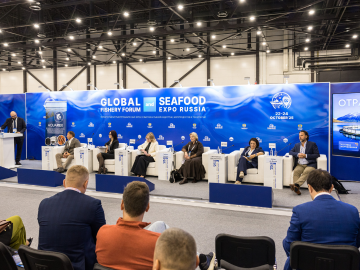
The roundtable "Technological Aspects of Cost-Effective Aquaculture" was held within the framework of AQUA FARM GLOBAL
More
The round table brought together representatives of science and business for an open dialogue
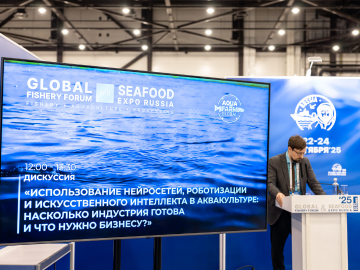
A rich discussion on the use of artificial intelligence in aquaculture and fisheries took place at the round table
More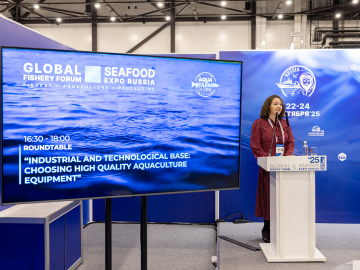
Choosing of high quality aquaculture equipment was discussed at AQUA FARM GLOBAL 2025
More
Kemal Cem Pülten, Editor-in-Chief, Aqua Life of Türkiye Publishing Group
MoreThis website uses , to ensure the best user experience and functionality of the site. By continuing to use this site, you agree to the use of cookies

